
Join the American Water Resources Association National Capital Region Section (AWRA-NCRS) for an evening of expert presentations and discussion on water quality challenges facing the Potomac Basin. From PFAS contamination to the historic January 2026 sewage spill, our region's water resources are facing unprecedented pressures. This event brings together researchers and practitioners to share the latest science and on-the-ground perspectives.
Speakers:
Dr. Stanley Grant, Occoquan Watershed Monitoring Laboratory, Virginia Tech
Sustainable Pathways for PFAS Management in a One Water systemGordon Michael Selckmann, Interstate Commission on the Potomac River Basin
Water Quality Monitoring in the Potomac BasinSarah Ahmed, Interstate Commission on the Potomac River Basin
Advancing Spill Response in the Potomac BasinClaire Barlow, Water Quality, Outreach and Wellness (WOW) Lab, University of Maryland
Environmental and Public Health Impacts of Sewer Overflows & Basement Backups
Registration:
Doors open at 4:30 pm. Presentations begin at 5:15 pm sharp. Dinner will be served.
Registration fee: $15 for members / $20 for non-members / Free for students
Registration deadline: May 12, 2026
Transportation and Parking: https://www.mwcog.org/directions/
Getting There: We strongly recommend taking Metro. The closest station is Union Station (Red Line), approximately a 5-minute walk. The COG garage will not be available for this event due to renovations. Street parking is very limited. If you must drive, Union Station parking garage is the nearest option.
Building Access: The event will be held in the Training Center on the first floor (lobby level). Registered attendees will receive an email with a QR code prior to the event for faster check-in. Upon arrival, scan your QR code at the iPad in the lobby and a badge will print automatically. If you do not receive a QR code, you can scan your driver's license at the iPad or visit the guard desk.
Presentation #1: Sustainable Pathways for PFAS Management in a One Water system

Stanley B. Grant is the Nick Prillaman Professor of Civil and Environmental Engineering at Virginia Tech and Director of the Occoquan Watershed Monitoring Laboratory. He received his undergraduate degree in geology from Stanford University and his PhD in environmental engineering science from the California Institute of Technology. His research focuses on solute transport, water quality, and One Water systems, with applications to freshwater salinization and PFAS contamination.
He has authored more than 100 peer-reviewed publications, including papers in Science and Nature, and has led over $25 million in research funding. He is a former member of the U.S. EPA Science Advisory Board and a recipient of the NSF CAREER Award and Virginia Tech’s Dean’s Award for Excellence in Research.
In this talk, Dr. Grant will describe a Water Research Foundation project aimed at mitigating PFAS pollution in the Occoquan Reservoir—a drinking water source for up to one million people in Northern Virginia and one of the first and largest indirect potable reuse systems in the United States. Combining high-frequency PFAS measurements, system-scale experiments, and facilitated stakeholder engagement, his team is translating actionable information on PFAS sources and processes into stakeholder-driven solutions that balance near- and long-term objectives and distribute costs and responsibilities across wastewater, watershed, and drinking water subsystems.
Presentation #2: Advancing Spill Response in the Potomac Basin: History, Real-Time Modeling, and Preparedness

Sarah Ahmed serves as Associate Director of Spills at the Interstate Commission on the Potomac River Basin (ICPRB), where she leads real-time spill response operations and the development of modeling tools that help protect drinking water sources across the Potomac River Basin. She works closely with utilities, state agencies, and regional partners during water quality incidents and also supports ICPRB’s CO-OP Section in long-term water supply planning, drought operations, and demand forecasting for the Washington metropolitan region. She holds an M.S. in Civil Engineering and a B.S. in Biological Resources Engineering from the University of Maryland, College Park.
The Potomac Basin has experienced a wide range of spill incidents over the past several decades, including fuel releases, chemical spills, wastewater discharges, and infrastructure failures, with the Potomac Interceptor Break serving as the latest reminder of ongoing risks to water quality and drinking water sources. This presentation will review the basin’s spill history and current vulnerabilities, then highlight how ICPRB’s Spill Response Section uses real-time modeling, contaminant travel time estimates, and regional coordination to support emergency response. The session will also discuss available tools, response processes, and opportunities to strengthen preparedness for future incidents.
Presentation #3:Environmental and Public Health Impacts of Sewer Overflows & Basement Backups

Claire Barlow is a Ph.D. candidate studying environmental health sciences at the University of Maryland. She works in the Water Quality, Outreach, and Wellness Laboratory, led by Dr. Rachel Rosenberg Goldstein, an assistant professor of global, environmental and occupational health. In the lab, Barlow studies microbial risks in water systems, including pathogen and antibiotic-resistant bacteria exposure from sanitary sewer overflows and household flooding events. She is also evaluating fecal contamination in drinking water in Varanasi, India, broadening the global scope of her work. She has an interest in environmental epidemiology, one health and molecular microbiology.
The Water Emergency Team (WET) project is evaluating sewage-impacted homes and surface water bodies as possible sources of exposure to antibiotic-resistant bacteria (ARB) and other waterborne pathogens. From the historic Potomac interceptor collapse to household backups in Maryland: what is in the water?
Presentation #4:The role of the Interstate Commission on the Potomac River Basin (ICPRB) in the Mid-Atlantic monitoring strategy
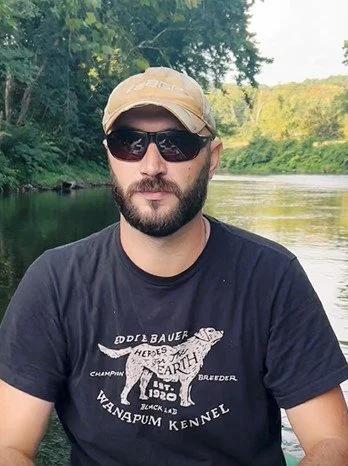
Gordon “Mike” Selckmann is the Associate Director of Aquatic Habitats at the Interstate Commission on the Potomac River Basin (ICPRB). He is responsible for evaluating and assessing the habitat quality and biological health of communities within Potomac waters. His work coordinates the cooperation of federal, state, academic, and local partners to find and implement solutions to environmental issues. Prior to joining ICPRB, Mr. Selckmann worked for the University of Maryland Chesapeake Biological Lab, Round River Conservation, and the Okavango Research Institute. He is currently the primary investigator and project coordinator for the ICPRB’s Large River Assessment, Harmful Algae Bloom Program, North Branch Potomac Tailwater optimization, and ground water biological studies. Mr. Selckmann holds a M.S. in Environmental Biology from Hood College – a BA in Biology from St. Mary’s College of Maryland.
The ICPRB was established by an Act of Congress in 1940 and later strengthened through a 1970 interstate compact, making it one of the earliest organizations mandated to manage water resources on a watershed basis rather than along political boundaries. Its member jurisdictions include Maryland, Virginia, West Virginia, Pennsylvania, the District of Columbia, and the U.S. federal government, each represented by appointed commissioners who guide policy and regional coordination. The Commission focuses on water quality, water supply, aquatic life, and land resource management, conducting scientific studies and facilitating cooperative planning to address pollution, drought resilience, and ecological health across the basin.
Over time, the ICPRB has played a coordination and role in improving the Potomac’s water quality, responding to threats such as population growth, land‑use changes, and chemical contaminants. It continues to serve as a hub for scientific expertise, public education, and interstate collaboration, helping ensure that the river—often called the “Nation’s River”—remains a sustainable resource for more than six million residents who depend on it. This presentation aims to highlight the ICPRB's role as a catalyst and coordinator in Potomac River research in support of it's state, federal, and regional partners.